Thickness variation is one of the most expensive hidden losses in sheet extrusion. When a line cannot hold a stable profile across width or along machine direction, the result is not only customer complaints. It also causes giveaway, extra trimming, unstable thermoforming, poor lamination performance, roll mismatch, and weaker confidence in line capability. For many processors, the cost of a sheet line is therefore not determined only by its maximum output. It is determined by how much usable product it can produce within tolerance.
Plastic sheet manufacturers work with a broad range of polymers such as PET, PP, PS, PC, ABS, PMMA, PVC, and multilayer structures. Each resin family behaves differently, but the root causes of thickness variation usually concentrate in a similar set of process areas: unstable feeding, inconsistent melt temperature, poor screen management, die-lip or bolt imbalance, melt-pump fluctuation, roll-stack settings, cooling inconsistency, haul-off mismatch, and insufficient measurement feedback. Because the causes interact, operators often waste time correcting the wrong stage first.
This article provides a process-first guide to controlling thickness variation in sheet extrusion. It explains where variation comes from, what numbers should be watched, how line components influence uniformity, and how buyers can evaluate whether a supplier’s sheet line is engineered for stable production rather than theoretical output alone.
Thickness variation is the measurable difference between the target sheet thickness and the actual thickness produced across the width, along the length, or between production lots.
In practice, converters usually evaluate variation in three ways. The first is cross-direction profile, meaning whether the left, center, and right sides of the sheet are uniform. The second is machine-direction fluctuation, meaning whether the thickness rises and falls as the roll is produced. The third is lot-to-lot consistency, meaning whether Monday’s production matches Thursday’s production under the same nominal settings.
Depending on the application, acceptable tolerance may vary widely. In many commercial sheet extrusion lines, processors try to keep thickness variation within around ±3% to ±5% of target for relatively demanding packaging applications, while other industrial uses may accept a wider window. The financial impact is easy to understand. If a plant makes a 1,000 mm wide sheet at 0.80 mm target thickness but must run an average of 0.84 mm to avoid thin spots, that extra material may represent roughly 5% giveaway before trim loss is even considered.
Thickness variation matters because it affects both quality and cost, making it one of the most direct indicators of a sheet line’s real production capability.
Downstream users feel thickness inconsistency quickly. In thermoforming, uneven sheet can cause unstable heating response, inconsistent draw, wall-thickness imbalance, and higher scrap at the forming stage. In printing and lamination, uneven gauge can affect tension, appearance, adhesion, and winding. In construction or electronics sheets, dimensional inconsistency may affect assembly performance or surface appearance.
The cost penalty can be large. Consider a line running 600 kg/h for 20 hours per day and 320 days per year. That equals 3,840 tonnes of annual throughput. If better gauge control reduces average material giveaway by only 2%, the saved saleable material equals about 76.8 tonnes per year. For resins with meaningful cost per tonne, thickness control becomes a strategic profit issue, not just a process detail.
That is why buyers of a plastic sheet extrusion machine should evaluate profile-control capability early in the project, especially if the final market has strict forming or converting requirements.
Material consistency influences thickness stability because unstable feed characteristics create unstable melt behavior, and unstable melt behavior eventually appears as sheet variation.
Different materials create different challenges. PET is moisture sensitive and viscosity sensitive. PP and PS can show profile shift when melt temperature and die balance drift. Filled materials may introduce rheology changes if filler loading is inconsistent. Recycled content can create lot-to-lot variability in melt flow, contamination level, or gas release. Even small fluctuations in bulk density at the feeder can translate into pressure and output instability later in the line.
Process discipline therefore starts before the extruder. Operators should monitor resin identification, blending accuracy, regrind ratio, moisture control where needed, hopper feed behavior, and contamination. In many plants, material-related variation can be reduced by standardizing drying time, checking loader performance, and recording batch-to-batch melt index or IV where relevant. A line with advanced gauging will still struggle if the incoming material system is inconsistent.
When buyers review plastic extrusion equipment, they should ask whether the supplier has considered the material preparation stage as part of the sheet-thickness solution. A sheet line quotation that ignores material stability is incomplete.
The extruder and melt system affect thickness variation because stable output, temperature, and pressure are the foundation of stable gauge control.
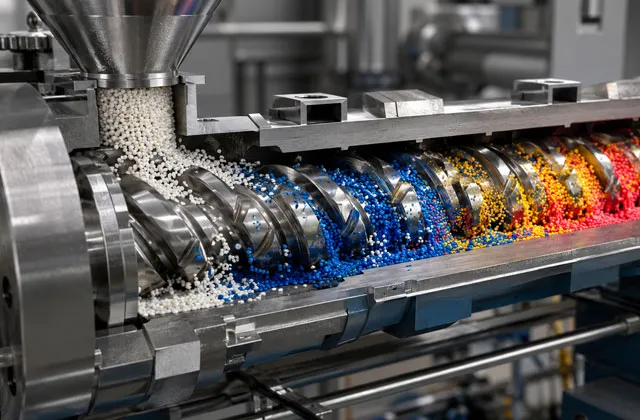
At the extruder level, screw design, barrel temperature zoning, motor control, and feeding consistency all influence output smoothness. A line that experiences surging at the extruder will often show periodic thickness fluctuation downstream. In some applications, the addition of a melt pump helps decouple die flow from pressure instability and creates a more stable throughput basis. Screen changer behavior also matters. As filter packs load with contamination, pressure rises and flow behavior changes. If screen changes are poorly timed or the filtering system is undersized, thickness variation may appear before operators connect the problem to filtration.
Temperature control is equally important. Melt that is too cold may produce uneven flow across the die. Melt that is too hot may lower viscosity and worsen edge behavior or sag. In many sheet lines, processors monitor melt temperature and pressure continuously and review trends during stable production runs. A sudden drift of only a few degrees Celsius or a visible pressure swing can be an early warning of thickness problems.
For supplier evaluation, buyers should ask not only “What is the output?” but “How stable is the output under continuous load?” In sheet extrusion, the stability of the melt system is often more valuable than a short-term peak number.
The T-die is the primary cross-direction shaping tool because it distributes melt across the sheet width and strongly influences whether the profile is balanced from edge to edge.
Die design includes manifold geometry, lip rigidity, thermal behavior, and bolt adjustment structure. Even a good extruder cannot overcome a poorly balanced die. Common die-related causes of thickness variation include uneven thermal expansion, incorrect lip gap settings, dirty lips, edge-bead instability, and mechanical distortion. Manual die-bolt adjustment requires experience, while automatic thermal or bolt-based profile systems can help in demanding applications.
Operators should also distinguish between profile problems caused by the die and problems caused by the downstream roll stack. If a profile changes immediately after a die adjustment, the die is likely involved. If the sheet exits the die well but shows change after cooling, the roll section may be contributing. This diagnostic separation saves a great deal of troubleshooting time.
For medium and larger projects, a supplier should be able to discuss die width, deckle strategy, heating zones, and the logic behind profile control. A buyer comparing plastic sheet extrusion machine offers should therefore verify how the die was selected for the intended material and target thickness range rather than accepting a generic die description.
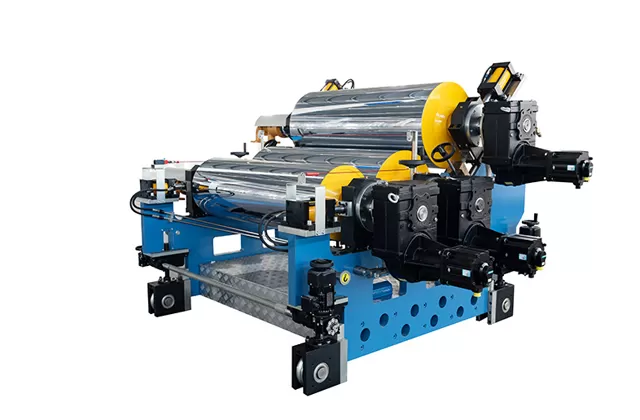
The three-roll stack plays a major role in thickness control because it calibrates, cools, and stabilizes the sheet immediately after die exit.
Roll temperature, parallelism, nip force, surface finish, and line speed all matter. If the rolls are not parallel, the sheet can show side-to-side variation even when the die is relatively balanced. If roll temperatures are inconsistent, the cooling rate may vary across width, affecting not only thickness but also flatness and gloss. In thin PET, PS, and PP applications, the timing of melt contact with the first roll is especially important because the sheet is still highly deformable at that stage.
Practical control requires both setup and maintenance. Operators should check bearing condition, hydraulic or pneumatic loading stability, temperature controller performance, and surface cleanliness. Even a small contamination spot on a roll can affect sheet appearance and create measurement noise. In some lines, roll-surface wear becomes a long-term source of inconsistency if preventive maintenance is delayed.
From a buying perspective, the roll stack should be evaluated as a precision section, not merely a support module after the extruder. This is often where lower-priced lines reveal their real limitations.
Online gauging and automatic thickness control are high-value process tools because they convert thickness correction from trial-and-error into data-based continuous control.
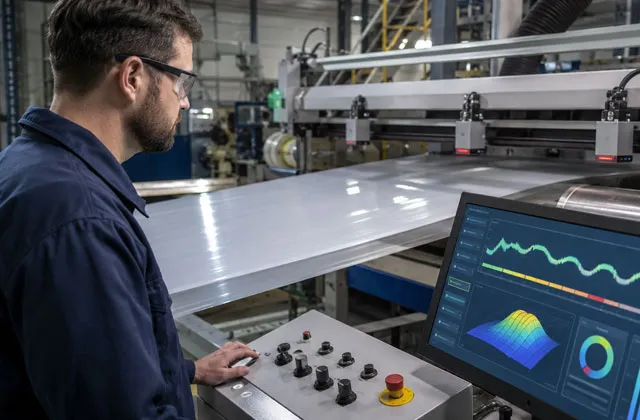
A modern gauge system can scan across the sheet, identify thin and thick zones, and provide profile maps for operators. In more advanced systems, that measurement connects to automatic die-bolt or thermal-bolt adjustment. This does not remove the need for operator skill, but it shortens correction time and improves consistency, especially during startups and grade changes.
For plants targeting low giveaway, the ROI can be compelling. Suppose a gauge-control system reduces average excess thickness by only 1.5% on a line producing 4,000 tonnes per year. That equals about 60 tonnes of annual material optimization. Even after accounting for real-world operating conditions, the savings can be significant enough to justify the system on many commercial lines.
However, the best results come when the line is mechanically stable first. Automatic control cannot permanently compensate for a damaged die, a surging extruder, or severe feeder inconsistency. Buyers should therefore view online gauging as part of a stable platform rather than a rescue tool for weak engineering.
Maintenance helps reduce thickness variation because many gauge problems come from gradual mechanical or thermal drift rather than dramatic machine failures.
Good maintenance practice includes routine checking of heater zones, thermocouples, drive stability, feeder calibration, screen-change intervals, die cleaning, roll parallelism, temperature-control loops, and gauge-system calibration. Plants that record trend data often identify problems earlier. For example, if melt pressure is slowly rising from one production week to the next, the issue may be filtration or screw wear. If edge profile worsens after maintenance shutdowns, the die setup procedure may need standardization.
Buyers evaluating plastic extrusion machine manufacturers should ask how the supplier supports maintenance documentation, spare-parts availability, and operator training. A well-designed line still depends on disciplined daily management, and the best suppliers help the customer build those routines.
Step-by-step troubleshooting is the fastest approach because it isolates the process stage causing variation instead of changing multiple variables at once.
A practical sequence is as follows. First, confirm the measurement. Check whether the online gauge is calibrated and whether manual measurements match the trend. Second, identify the variation pattern: across width, along length, or both. Third, review material conditions and feeder stability. Fourth, check melt temperature and pressure trends. Fifth, inspect screen status and recent screen-change history. Sixth, evaluate die settings and lip cleanliness. Seventh, check roll temperatures, nip, and parallelism. Eighth, review line speed changes and haul-off stability.
This sequence matters. If operators begin by adjusting die bolts when the real problem is surging from feed inconsistency, they may make the profile worse. Likewise, if they blame the extruder when only one roll-temperature loop has drifted, they will waste time and resin. Standardizing the troubleshooting order reduces both downtime and scrap.
Startups, changeovers, and line-speed changes affect thickness variation because the line is most unstable when melt history, thermal equilibrium, and downstream tension are still moving toward balance.
Many operators focus on stable full-speed production, but a large amount of scrap is actually created during acceleration, grade change, and restart. During startup, the die and rolls may not yet be in full thermal balance. Melt pressure may still be climbing toward its operating window. A profile that appears acceptable at 10 m/min may shift once the line accelerates to 25 m/min or 40 m/min. Likewise, a thickness setting that works for a 0.50 mm product may not transfer directly to a 0.80 mm product without changes in die gap, bolt balance, roll temperature, and haul-off conditions.
Good plants therefore standardize startup and changeover procedures. These procedures may include defined warm-up times, target temperature windows, pressure stabilization checkpoints, roll-gap references, and the sequence for gauge-control activation. If the line includes online profile control, operators should know when to switch from manual to automatic correction. If this handover is too early, the system may chase temporary instability; if it is too late, more scrap is produced than necessary.
Line-speed changes should also be documented carefully. When speed increases, the residence time, cooling behavior, and tension pattern all change. If the die and roll stack cannot follow smoothly, thickness variation may increase even though the extruder itself appears stable. A supplier with real sheet-line experience should be able to explain how the line behaves during acceleration, not only at a fixed laboratory-style operating point.
Buyers should verify thickness-control capability before purchase because a line that cannot prove stable gauge performance under realistic conditions may create years of unnecessary material loss.
The first step is to define the required tolerance and test basis. Ask the supplier to specify resin type, target thickness, width, output, and line speed for any quoted gauge-performance claim. Without those conditions, the number has limited value. The second step is to request trial data or case references from similar applications. A PET packaging sheet line and an ABS industrial sheet line may require very different profile-control strategies.
The third step is to review the complete hardware logic. Does the proposal include a melt pump? What type of screen changer is used? How many die heating zones are provided? Is the three-roll stack engineered as a precision section? Is online gauging standard or optional? If automatic profile correction is offered, what correction method is used and what response time is typical? These questions help distinguish a robust production line from a basic extrusion layout.
The final step is to align performance expectations with business goals. If the customer mainly produces general-purpose sheet with a wide tolerance band, a simpler system may be adequate. If the customer sells to demanding thermoforming or converting markets, tighter gauge control may justify a higher initial investment. Good supplier evaluation is therefore a business decision as much as a technical one.
A checklist and comparison table are useful because they connect process theory with operational decision-making on the factory floor.
| Process Area | Main Risk | Typical Symptom | Primary Control Action |
| Material handling | Moisture, blend inconsistency, unstable feed | Lot-to-lot variation, surging | Stabilize drying, blending, and feeding |
| Extruder | Output fluctuation, temperature drift | Machine-direction gauge oscillation | Check screw load, temperature, drive stability |
| Screen changer / filtration | Pressure rise, flow restriction | Gradual gauge drift, instability before change | Optimize filtration and screen-change schedule |
| T-die | Poor distribution, lip imbalance | Cross-direction profile problems | Clean die, verify heating zones, adjust lip/profile control |
| Three-roll stack | Non-parallel rolls, temperature imbalance | Gauge distortion after cooling, flatness issues | Check parallelism, nip, roll temperatures |
| Measurement system | Weak feedback or bad calibration | Late corrections, false adjustments | Calibrate gauge and connect data to correction logic |
| Maintenance | Slow mechanical drift | Recurring variation despite resets | Use preventive checks and trend logs |
The conclusion is simple because good thickness control is not a single-device feature; it is the result of a stable material system, a stable melt system, a balanced die, a precise roll stack, and disciplined measurement.
If a plant wants lower giveaway and better downstream performance, it should stop viewing thickness variation as an isolated quality complaint. It should treat it as a full-line engineering issue. Buyers selecting a new sheet line should therefore pay close attention to die design, roll-stack precision, melt stability, and gauge-control strategy, not just output and price. For existing plants, the fastest gains often come from structured troubleshooting and better maintenance routines rather than constant ad hoc adjustments.
JWELL’s role in this context is to match line configuration with product requirements and help customers evaluate the real production conditions that affect sheet gauge. When sending an RFQ, buyers should provide resin type, target thickness range, width, output target, downstream converting requirements, and tolerance expectations so that the line can be configured for stable saleable production.
1. What is the most common cause of sheet thickness variation?
There is no single universal cause, but unstable feeding, die imbalance, roll-stack misalignment, and poor measurement feedback are among the most common sources. The actual cause depends on whether the variation is across the width, along the length, or linked to certain materials or operating conditions.
2. Can online thickness gauging eliminate all variation?
No. Online gauging improves visibility and can support faster correction, but it cannot permanently solve severe mechanical or process instability by itself. The base line still needs stable material handling, melt delivery, die behavior, and roll-stack control.
3. How tight should thickness tolerance be?
The correct tolerance depends on the application. In many packaging or converting applications, processors try to maintain a relatively tight tolerance window, often around ±3% to ±5% depending on thickness and product use. The customer’s downstream process ultimately defines the economically sensible target.
4. Why does excess thickness increase cost so much?
Because even a small average over-thickness becomes large material giveaway at high annual tonnage. A line making several thousand tonnes per year can lose dozens of tonnes of resin simply by running above target to avoid thin spots.
5. Does recycled material make thickness control harder?
It can. Recycled content may increase variability in melt behavior, contamination, or moisture sensitivity depending on the polymer and preparation quality. This does not mean recycled content cannot run well, but it does mean the process window may require tighter control.
6. What should I ask a sheet line supplier before buying?
Ask about stable output basis, die design logic, roll-stack precision, gauge-control options, test conditions, maintenance support, and the supplier’s references with your target resin and product thickness. These questions are more valuable than asking only for nameplate capacity.


Jwell started manufacturing screws and barrels in 1978, making it one of the earliest screw and barrel manufacturers in China. Its brand, "Jinhailuo", has become well recognized in the industry. In 1997, Jwell was established to begin the production of extrusion machinery. Today, Jwell is the vice president unit of the China Plastics Machinery Industry Association and one of the technology leaders in the extrusion machinery industry.