A plastic pipe extrusion project is not defined by pipe diameter alone. Resin behavior, pressure class, wall thickness, standard dimensional ratio, layer structure, line speed, cooling demand, ovality, surface quality, marking, coiling or cutting, and factory utilities all affect the production-line design. Two lines that both claim to make 110 mm pipe may require different extruders, tooling, calibration, cooling, haul-off force, and controls if one produces thin-wall conduit and the other produces pressure-rated water pipe.
This guide follows the material from feeding to finished pipe and explains where production stability is won or lost. It is intended for pipe manufacturers planning a new factory, expanding capacity, replacing an older line, adding a new diameter range, or evaluating a supplier. It also shows how to prepare a technical RFQ, how to interpret output claims, and how to structure factory acceptance so that a quotation becomes a measurable production commitment.
JWELL states that its extrusion machinery business began in 1997 and that the company operates eight large production bases with more than 700,000 square meters of manufacturing space and more than 3,000 employees. For a pipe buyer, those figures are useful only when the proposed project identifies the responsible production base, engineering team, tooling capability, trial arrangement, commissioning plan, and long-term support scope.
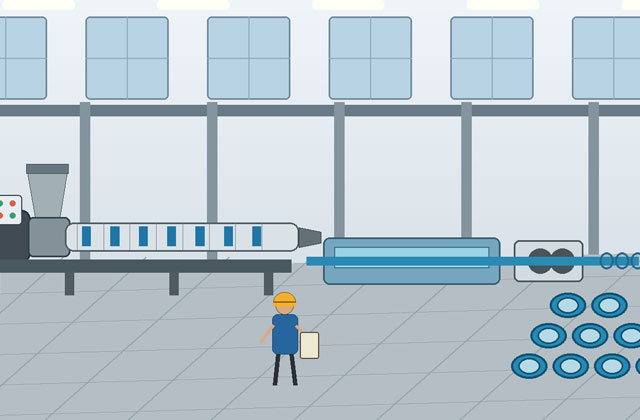
A plastic pipe extrusion line is a continuous manufacturing system that prepares and feeds polymer, plasticizes it in an extruder, forms a tubular melt through a die head, calibrates and cools the pipe, pulls it at controlled speed, and cuts or coils it to the required length.
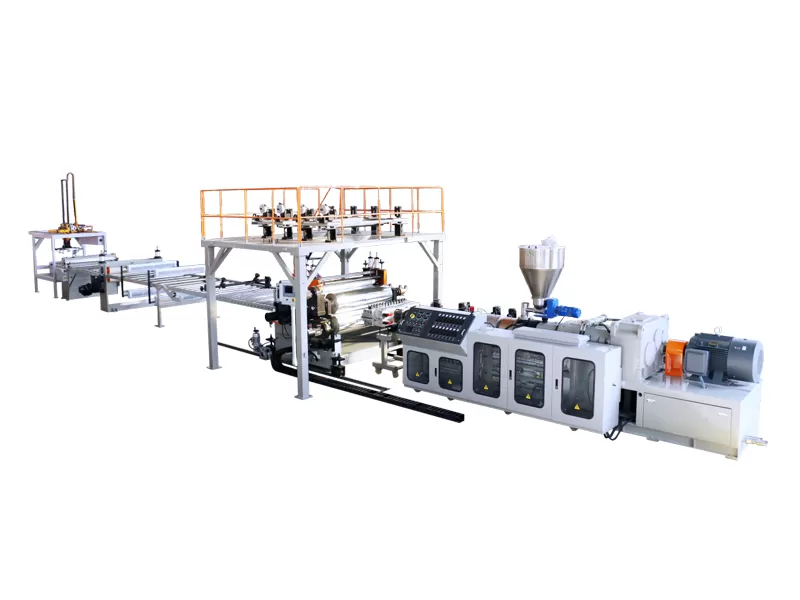
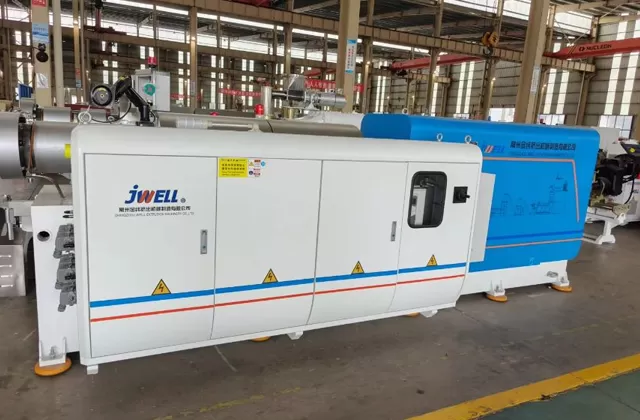
The complete line normally includes raw-material handling, dosing, one or more extruders, a die head, calibration sleeves, vacuum and spray cooling tanks, a haul-off, printer or marker, cutter or coiler, and a synchronized control system. Additional equipment may include gravimetric control, wall-thickness measurement, ultrasonic gauges, automatic socketing, perforating, threading, winding, bundling, scrap crushing, chilled-water systems, and centralized material supply.
The process is continuous, so each section must remain balanced. If the extruder output fluctuates, wall thickness changes. If vacuum or cooling is unstable, diameter and ovality drift. If haul-off speed oscillates, weight per meter changes. If the cutter is not synchronized, ends deform or lengths vary. A strong plastic pipe extrusion machine proposal therefore explains the complete process, not only the main extruder.
A plastic pipe extrusion line works by converting solid polymer into a homogeneous pressurized melt, shaping it into an annular tube, fixing the outside diameter under vacuum, removing heat, and matching haul-off speed to output so that the target wall thickness is maintained.
Material preparation: Resin, stabilizers, fillers, pigments, regrind, or masterbatch are dried, blended, conveyed, or dosed as required by the formulation.
Feeding: Material enters the extruder through volumetric or gravimetric feeding. Consistent feed rate supports stable output and weight per meter.
Plasticizing: The screw conveys, compresses, melts, mixes, and pressurizes the polymer while barrel heating and cooling keep the process within its operating window.
Filtration and melt transfer: Depending on material and quality requirements, the melt may pass through screens, a breaker plate, an adapter, or a melt pump before reaching the die.
Die forming: The pipe head divides and recombines the melt around a mandrel, producing a tubular parison with a controlled initial wall distribution.
Calibration: The hot pipe enters a calibration sleeve. Vacuum pulls the outer surface toward the calibrator while cooling begins to lock the diameter.
Cooling: Vacuum and spray tanks remove enough heat to prevent deformation under haul-off, cutting, coiling, and storage.
Haul-off: Belts, caterpillars, or tracks pull the pipe at controlled speed. The ratio between melt output and haul-off speed determines wall thickness and weight per meter.
Inspection and marking: Diameter, wall thickness, ovality, surface, print, spark testing, or other quality variables are checked.
Finishing: The pipe is cut, chamfered, socketed, threaded, perforated, coiled, bundled, or stacked according to product requirements.
The process is easier to control when the line records melt pressure, melt temperature, screw speed, drive load, vacuum, cooling-water temperature, haul-off speed, dimensional measurements, and alarm history. These variables help operators distinguish material, extrusion, die, cooling, and traction problems.
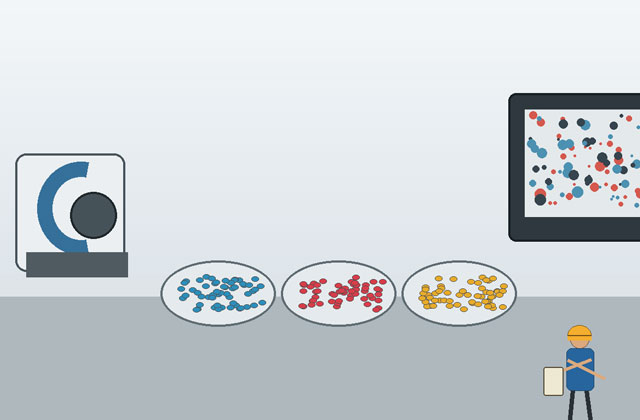
A plastic pipe extrusion line can process thermoplastics such as PVC, HDPE, MDPE, LDPE, PP-R, PP-H, PE-RT, PE-X-related systems, PA, TPU, TPE, and biodegradable formulations, but each material requires a different processing strategy.
| Material | Typical Pipe Applications | Process Priorities | Common Extruder Approach |
|---|---|---|---|
| Rigid PVC / UPVC / CPVC | Water supply, drainage, conduit, industrial and construction pipe | Heat stability, fusion, formulation consistency, venting, residence time, die pressure | Conical or parallel counter-rotating twin-screw, depending on output and formulation |
| HDPE / MDPE | Water, gas, drainage, telecom duct, large-diameter pipe, corrugated pipe | Melt homogeneity, cooling, sag control, wall-thickness stability, oxidation protection | High-efficiency single-screw; co-extruders for stripes or multilayer structures |
| PP-R / PP-H | Hot and cold water, industrial piping, chemical applications | Dimensional stability, layer adhesion, surface, color consistency, controlled cooling | Single-screw main extruder with optional co-extrusion |
| PE-RT and multilayer systems | Heating pipe, hot-water applications, barrier or reinforced structures | Layer-ratio accuracy, adhesion, concentricity, compact die design, online control | Multiple synchronized extruders and multilayer die head |
| PA / TPU / TPE | Automotive tubes, pneumatic tubes, medical or specialty tubing | Drying, small-output stability, precision dimensions, surface and cleanliness | Precision single-screw or specialty extruders with fine control |
| Recycled PE/PP blends | Non-pressure drainage, conduit, cores, selected technical products | Contamination, filtration, odor, moisture, output stability, product standard limits | Single-screw with enhanced feeding, venting and filtration; formulation-dependent |
Material identification should be specific. “HDPE” does not define melt flow rate, density, pipe grade, additive package, recycled content, or standard. “PVC” does not define K-value, filler loading, stabilizer, impact modifier, lubricant balance, or bulk density. The supplier needs the formulation or representative process data to select the screw, gearbox, heating and cooling, feeder, venting, die, and wear protection.
An extruder for PVC pipe should provide controlled solids conveying, fusion, mixing, venting, and pressure generation while minimizing thermal degradation of the heat-sensitive formulation.
Rigid PVC pipe production frequently uses conical or parallel counter-rotating twin-screw extruders. The correct choice depends on formulation, pipe size, output, plant experience, and line architecture. Conical designs can offer strong feeding and pressure development in a compact format. Parallel designs may be selected for higher outputs or specific production strategies. The supplier should explain the design basis instead of presenting one configuration as universally superior.
PVC output depends on more than motor power. Powder bulk density, dry-blend temperature, filler level, lubrication, screw wear, barrel cooling, vacuum venting, die resistance, and downstream capacity all matter. A formulation that runs well on one screw geometry may not behave identically on another. If the buyer uses a high-calcium-carbonate formulation or plans to vary the recipe, that information must be disclosed before the guarantee is set.
For small-diameter pipe, double-strand or four-strand production can increase total output by producing multiple pipes simultaneously. This is not simply a larger die. Each strand requires stable melt distribution, individual calibration, cooling, traction, and cutting control. JWELL’s existing PVC two-cavity and four-cavity product architecture is therefore a useful starting point, but the proposal should state pipe diameters, line speed, output per strand, independent adjustment functions, and acceptance criteria.
An extruder for HDPE pipe should deliver high, stable output with good melt homogeneity and low thermal variation while supporting the cooling and dimensional control required by the target diameter and wall thickness.
High-efficiency single-screw extruders are commonly used for HDPE pipe. Barrier screw designs, efficient feeding, optimized cooling, and appropriate drive power can improve output without relying only on high screw speed. However, output must be balanced with melt temperature. Excessive melt temperature increases cooling demand, can worsen sag in large-diameter thick-wall pipe, and may reduce line efficiency even when the extruder produces more kilograms per hour.
Large-diameter pipe requires special attention to die-head flow distribution, wall-thickness adjustment, internal and external cooling, sag control, support rollers, haul-off force, cutting, and safe handling. A quotation for a 1,200 mm or 2,700 mm line should include plant layout, foundation loads, cooling-water flow and temperature, crane requirements, material storage, pipe handling, and the practical time needed to change sizes.
For pressure pipe, the machine must support the applicable material and product standard. ISO 4427 covers polyethylene piping systems for water supply and pressure drainage applications. The equipment supplier does not replace the pipe manufacturer’s responsibility for formulation, testing, certification, and quality management, but the line should be designed to produce stable dimensions and traceable process data.
Single-layer pipe extrusion uses one main material stream, while multilayer pipe extrusion combines two or more synchronized melt streams to create functional, economic, visual, or reinforced layers.
A multilayer structure may use a virgin outer layer and recycled core, an oxygen-barrier layer, a colored stripe, a protective skin, a glass-fiber-reinforced layer, or different polymers selected for pressure, temperature, chemical, or cost performance. Each additional layer introduces new variables: extruder stability, layer ratio, melt temperature compatibility, interfacial adhesion, die residence time, concentricity, startup scrap, and control coordination.
The RFQ should include a cross-section showing each layer, material, target thickness or percentage, tolerance, and purpose. The supplier should define how layer ratios are controlled, whether gravimetric systems are included, where pressure and temperature are measured, how the die is adjusted, and how layer distribution will be verified during FAT.
Pipe die design affects wall thickness and surface quality by controlling melt distribution, pressure drop, weld-line behavior, residence time, shear, and the initial concentricity of the tubular melt.
Spiral, basket, spider, or other die concepts may be selected based on material, diameter, layer structure, output, and product requirements. The relevant question is not the name alone. Ask how the die balances flow, how centering is adjusted, how long material remains inside, how surfaces are heated, how dead zones are minimized, and how the head is cleaned or changed.
For heat-sensitive PVC, residence time and stagnant areas are critical. For HDPE pressure pipe, melt distribution and thermal uniformity influence wall thickness and surface. For multilayer pipe, each flow channel must deliver the correct layer without excessive interfacial instability. For small medical or automotive tubing, cleanliness and precision can be more important than maximum output.
Tooling scope should state which die parts, mandrels, calibration sleeves, heating zones, carts, lifting devices, and change parts are included for each diameter. A quotation that covers “20–110 mm” does not necessarily include complete tooling for every size.
Vacuum calibration and cooling define line speed because the hot pipe must reach sufficient dimensional stability before traction, cutting, coiling, or handling forces can deform it.
The required cooling length depends on material, diameter, wall thickness, melt temperature, line speed, water temperature, ambient conditions, and acceptable residual heat. Thick-wall large-diameter pipe stores much more heat than thin-wall conduit. A high-output extruder therefore needs a proportionally capable cooling system. Adding extruder power without sufficient cooling can create a line that reaches the quoted output only at unacceptable water temperatures or dimensional variation.
Evaluate vacuum control range, pump redundancy, water separation, filter access, spray-nozzle design, tank length, lid and seal design, pipe support, height adjustment, temperature monitoring, and drainage. For multilayer or glossy pipe, cooling strategy can influence surface and internal stress. For flexible tubing, the calibrator and cooling path must prevent flattening or drag marks.
Utility calculations should include water flow, inlet temperature, temperature rise, chiller or cooling-tower capacity, pump head, water quality, and seasonal ambient conditions. A line tested with 15°C water may not perform identically in a plant where summer water enters at 28°C.
Haul-off and cutting equipment maintain pipe quality by controlling line speed, pulling force, product support, cut timing, and end condition without crushing, slipping, marking, or distorting the pipe.
Small tubing may use belt haul-offs. Medium and large pipe may require two-, three-, four-, six-, eight-, or multi-caterpillar designs to distribute force around the circumference. The correct number depends on diameter range, wall thickness, product stiffness, speed, and required traction. More tracks are not automatically better; the design must provide alignment, pressure control, synchronization, easy size adjustment, and service access.
Cutting method depends on material and product. Planetary saws, chipless cutters, flying knives, guillotines, or specialty systems may be used. Pressure pipe may require square ends and chamfering. Medical or automotive tubing may be coiled or cut at high precision. Corrugated pipe uses synchronized cutting related to corrugation pitch. The proposal should define length tolerance, cut quality, dust or chip extraction, noise control, and tooling changes.
Plastic pipe extrusion output should be estimated from product weight per meter, stable line speed, operating availability, and first-pass yield rather than from extruder capacity alone.
The basic relationship is:
Output in kg/h = pipe weight in kg/m × line speed in m/min × 60.
If a pipe weighs 2.5 kg per meter and the stable line speed is 8 m/min, the gross output is 1,200 kg/h. If the cooling system, haul-off, or cutter can support only 6 m/min at the required tolerance, practical gross output falls to 900 kg/h. If first-pass yield is 97%, saleable output is approximately 873 kg/h.
Annual capacity should include availability. A line scheduled for 7,200 hours per year at 873 kg/h and 85% availability produces about 5,343 tonnes of saleable pipe. Raising uptime from 85% to 90% adds roughly 314 tonnes per year without increasing screw speed. This is why maintenance access, changeover time, startup stability, and spare parts can be financially more important than a small difference in maximum output.
For multi-strand PVC production, calculate each strand separately and verify that all strands meet dimensional and surface requirements simultaneously. Total output is not acceptable if one pipe frequently drifts out of tolerance.
Plastic pipe extrusion line configurations should be compared on the same material, pipe standard, diameter, wall thickness, stable output, utility condition, included scope, and acceptance method.
| Comparison Item | Weak Proposal | Strong Proposal |
|---|---|---|
| Output | Maximum kg/h without product condition | Stable net output at defined pipe, resin, tolerance and run duration |
| Diameter range | Broad range with unspecified tooling | List of included dies, mandrels, calibrators and change parts |
| Cooling | Tank length only | Cooling calculation, water conditions, pumps, vacuum range and line-speed basis |
| Controls | PLC brand | Measured variables, synchronization, recipes, alarms, trends, data export and access levels |
| Energy | Installed motor power | Specific-energy test boundary at agreed output |
| Acceptance | General trial | Defined material, pipe, standard, output, quality tests, duration and pass/fail criteria |
| Service | “Worldwide service” | Named commissioning scope, response process, training, software backup and spare-parts plan |
Use a deviation list to record assumptions. If one supplier includes automatic wall-thickness measurement and another does not, the quotations are not directly comparable. If one supplier bases output on virgin pipe-grade resin and another accepts a high-recycled-content blend, the technical risk differs.
A plastic pipe extrusion line RFQ should define the pipe, resin, standard, diameter range, wall thickness, layer structure, output, utility conditions, automation, tooling, finishing, and acceptance requirements.
Pipe application: water, gas, drainage, conduit, medical, automotive, telecom, heating, industrial, or other.
Applicable standard and certification responsibility.
Material grade, formulation, recycled content, masterbatch, filler, and additives.
Diameter range, SDR or wall-thickness range, tolerance, ovality, surface and color.
Single-layer or multilayer structure, including each layer ratio.
Normal and maximum output for representative sizes.
Straight length, coiling size, socketing, threading, chamfering, perforating, marking, bundling, or packaging.
Required online measurement, gravimetric control, data storage, MES connection, and remote support.
Available floor space, ceiling height, crane, foundation, voltage, cooling water, compressed air, and ambient conditions.
FAT material, pipe size, test duration, output, quality tests, energy measurement, and sample retention.
Attach drawings, samples, and resin data sheets. For a new product, identify which variables are fixed and which may be developed jointly. The proposal should distinguish guaranteed conditions from estimated performance.
Factory acceptance testing for a pipe line verifies that the complete system can start, stabilize, produce, measure, and finish an agreed pipe under documented conditions before shipment.
A useful FAT has four stages. First, inspect mechanical assembly, guarding, lubrication, alignment, electrical cabinets, labeling, documentation, and utilities. Second, perform dry tests of motors, heaters, cooling, vacuum, alarms, interlocks, haul-off, cutter, and communication. Third, run representative material and establish stable conditions. Fourth, record performance for an agreed period.
The loaded test should measure resin consumption, net pipe output, line speed, weight per meter, diameter, wall thickness at multiple positions, ovality, surface, print, cut length, socket or coil quality, scrap, melt pressure, melt temperature, motor load, vacuum, water temperature, and energy boundary. For multilayer pipe, verify layer distribution. For pressure pipe, retain samples for required laboratory testing even if full certification is completed later at the buyer’s facility.
Agree how nonconformities will be handled. Some issues can be corrected before shipment; others may require retesting. The FAT report should identify the software version, parameter recipe, tooling used, measuring instruments, calibration status, raw material batch, and retained samples.
An extruder machine manufacturer for pipe projects should demonstrate material knowledge, tooling and screw capability, complete-line integration, documented trials, project engineering, and service support for the target market.
When reviewing an extruder machine manufacturer, ask which production base builds the line, who designs the screw and die, which components are manufactured internally, and where the FAT will occur. Inspect reference lines that are similar in material, diameter, and output, not only general factory videos.
JWELL lists pipe lines for PP-R, PE-RT, PE-X-related applications, HDPE water and gas pipe, silicon-core duct, corrugated pipe, RTP, PLA straw tube, automotive tube, insulation pipe, MPP conduit, fiberglass PPR, UPVC/CPVC, multi-strand PVC, medical tube, and PVC-O. This range shows broad product coverage, but the buyer should still confirm which team has direct experience with the exact application and what performance has been demonstrated.
Service planning should be project-specific. Define installation supervision, mechanical and electrical responsibilities, process commissioning, operator training, trial resin, local lifting and labor, travel, accommodation, remote support, spare parts, and warranty exclusions. “Worldwide after-sales service” becomes meaningful only when responsibilities, response steps, and costs are written into the contract.
Plastic extrusion equipment fits into a pipe factory as part of a larger material, utility, quality, maintenance, and logistics system that must be designed around the production plan.
The line layout should allow safe raw-material delivery, silo or bag handling, forklift movement, tooling storage, die cleaning, pipe transfer, scrap return, sample inspection, maintenance access, and finished-goods storage. Large pipe requires cranes, roller conveyors, cutting and handling zones, and sufficient turning radius. Small multi-strand lines require organized downstream lanes and packaging stations.
Buyers comparing plastic extrusion machine options should request a layout with maintenance clearances, utility connection points, foundation loads, operating platforms, exhaust locations, and emergency access. A line that fits on paper may be difficult to operate if screens, dies, pumps, cutter blades, or electrical cabinets cannot be serviced safely.
Quality planning should include incoming resin inspection, moisture or bulk-density checks, formulation control, in-process measurements, laboratory tests, traceability, nonconforming-material handling, and calibration. The equipment supplier should identify which controls are built into the line and which remain the pipe manufacturer’s responsibility.
JWELL can support a plastic pipe extrusion project by translating the buyer’s resin, product standard, diameter range, output, utilities, and automation needs into a balanced line proposal and documented acceptance plan.
The most useful starting package includes pipe drawings or standards, resin grade and formulation, representative diameter and wall thickness, normal output, annual production, finishing requirements, local utilities, plant layout, and commissioning expectations. JWELL can then define the extruder, screw and barrel, die head, calibration and cooling length, haul-off, cutter or coiler, controls, online measurement, tooling, utilities, and project scope.
For an existing factory, operating data from the old line is valuable. Provide actual output, melt temperature, motor load, cooling-water temperature, scrap causes, changeover time, quality complaints, and maintenance history. The replacement project can then target measured constraints rather than generic “higher efficiency.”
A complete pipe line normally includes material handling and dosing, an extruder, die head, calibration sleeve, vacuum tank, spray cooling tanks, haul-off, printer, cutter or coiler, and synchronized controls. Depending on the product, it may also include co-extruders, gravimetric control, wall-thickness gauges, socketing, perforating, threading, chamfering, bundling, scrap recycling, chillers, and compressors.
Choose equipment around the resin and product standard. Rigid PVC commonly uses counter-rotating twin-screw extrusion and requires careful fusion and thermal control. HDPE pipe commonly uses a high-efficiency single-screw extruder and requires strong melt homogeneity, cooling, sag control, and dimensional stability. The downstream line, die, tooling, and utility demand also differ significantly.
Output is determined by resin, screw design, motor and gearbox, melt temperature, die resistance, pipe diameter and wall thickness, cooling capacity, haul-off and cutter limits, and required dimensional quality. The correct figure is stable net good output at an agreed pipe specification, not the extruder’s short-term maximum discharge.
Cooling water removes the heat that must leave the pipe before it can resist deformation. Water inlet temperature, flow, tank length, spray design, vacuum stability, pipe wall thickness, and line speed all affect cooling. If the plant’s water is warmer than the supplier’s test water, the practical line speed may be lower unless additional cooling capacity is provided.
Yes, within a designed range, but each size may require dies, mandrels, calibration sleeves, seals, supports, cutter settings, and sometimes different downstream equipment. Very broad ranges can create long changeovers or compromises in efficiency. The quotation should list all included tooling and the expected output for representative small, medium, and large sizes.
Send the pipe application and standard, material grade and formulation, diameter and wall-thickness range, layer structure, target output, length or coil requirements, online inspection needs, utilities, plant layout, delivery location, and installation scope. Include drawings, samples, and information about recycled content or fillers. This allows JWELL to balance the extruder and downstream system more accurately.
A plastic pipe extrusion line should be engineered as one synchronized process. The extruder must match the resin and formulation. The die must distribute the melt uniformly. Calibration and cooling must support the real line speed. Haul-off, cutting, coiling, measurement, controls, and utilities must preserve the target dimensions and surface. The correct output is stable saleable pipe, not an isolated maximum number.
Buyers can reduce risk by defining representative pipe sizes, material, standard, output, layer structure, utility conditions, included tooling, and FAT criteria before comparing suppliers. JWELL’s broad pipe-line portfolio and manufacturing resources can support many applications, but the final decision should be based on a project-specific process explanation, scope boundary, trial evidence, commissioning plan, and lifecycle support commitment.
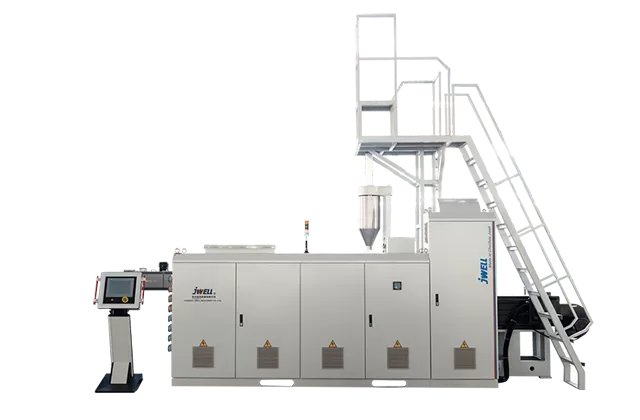
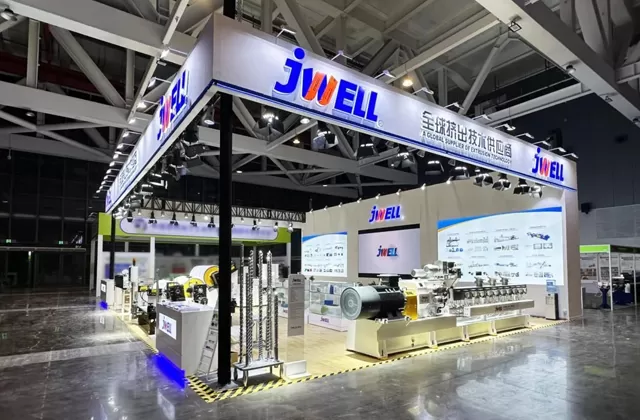
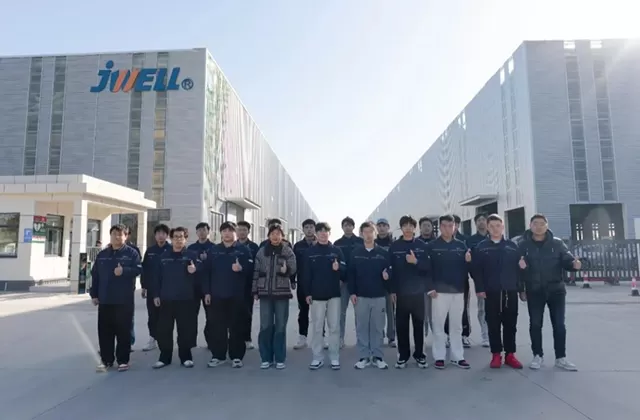
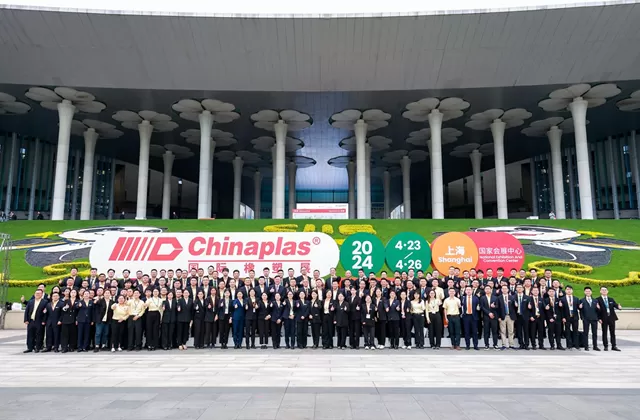
Jwell started manufacturing screws and barrels in 1978, making it one of the earliest screw and barrel manufacturers in China. Its brand, "Jinhailuo", has become well recognized in the industry. In 1997, Jwell was established as a plastic extrusion machinery manufacturer and began the production of extrusion machinery. Today, Jwell is the vice president unit of the China Plastics Machinery Industry Association and one of the technology leaders in the extrusion machinery industry.