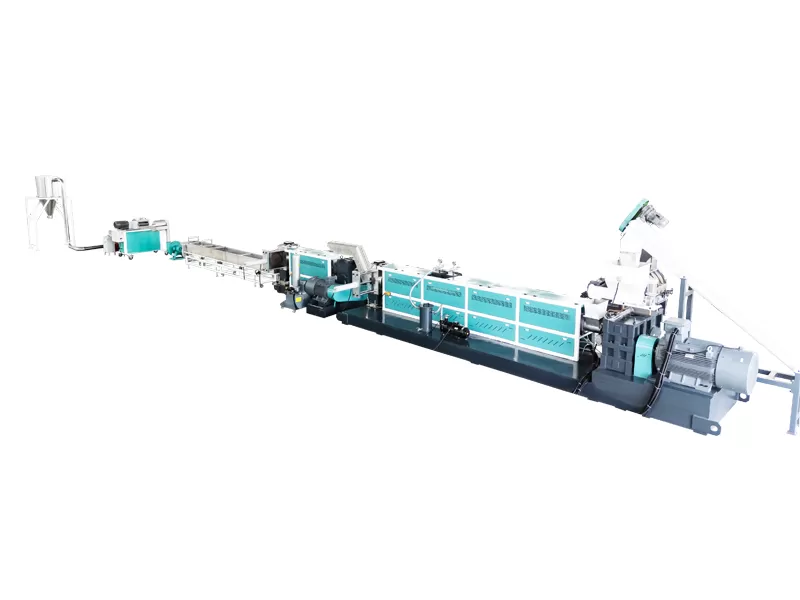
Consistent masterbatch quality depends on much more than mixing pigment or additives into a polymer carrier. A commercial masterbatch extrusion line must accurately meter raw materials, melt and wet the additives, provide controlled dispersive and distributive mixing, remove moisture and volatiles, stabilize melt pressure, and produce pellets with predictable dimensions.
For this reason, the twin-screw extruder is the process core, but it is not the entire quality system. Feeding, screw configuration, temperature control, venting, filtration, pelletizing, and quality monitoring must all work within a coordinated process window.
Masterbatch production requires both dispersive and distributive mixing. Dispersive mixing reduces pigment or filler agglomerates, while distributive mixing distributes the particles consistently throughout the polymer melt.
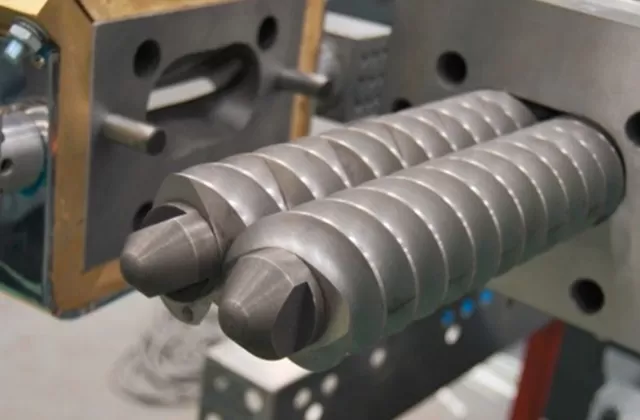
A co-rotating twin-screw system allows the screw profile to be divided into different functional zones. Conveying elements move the material forward, melting sections establish a homogeneous polymer phase, kneading and mixing elements introduce controlled shear, venting sections remove volatiles, and pressure-building sections prepare the melt for filtration and pelletizing.
However, maximum shear is not automatically desirable. Excessive shear can increase melt temperature, damage sensitive additives, increase energy consumption, and accelerate wear. The correct screw configuration is the one that delivers the required dispersion within the required thermal and residence-time window.
Feeding is often the first place where masterbatch consistency can be lost. Pigments, fillers, polymers, and functional additives can have substantially different bulk densities and flow properties.
When the formulation contains low-density powders or materials with poor flowability, volumetric feeding can become difficult to control. Gravimetric or loss-in-weight feeding provides a more direct method of controlling mass flow.
The objective is not merely accurate initial dosing. The feeder must maintain stable flow during the entire production run, including changes in hopper level and variations in powder flow behavior.
Screw design determines where melting occurs, where additives are incorporated, how much shear is applied, how long the material remains in the mixing zones, and how pressure develops toward the die.
| Process Zone | Main Function | Typical Quality Concern |
|---|---|---|
| Feeding zone | Stable solid conveying | Bridging and feed fluctuation |
| Melting zone | Establish polymer melt | Incomplete melting or overheating |
| Dispersive mixing | Break down agglomerates | Excessive shear |
| Distributive mixing | Homogenize formulation | Insufficient residence time |
| Devolatilization | Remove moisture and volatiles | Poor vacuum efficiency |
| Pressure-building zone | Prepare melt for filtration | Pressure fluctuation |
| Pelletizing | Produce consistent pellets | Fines and irregular pellet geometry |
JWELL's technical material on twin-screw masterbatch extrusion emphasizes the relationship between screw configuration, process optimization, dispersion, quality control, and troubleshooting.
Poor dispersion can originate from inadequate wetting, insufficient shear, unstable feeding, an unsuitable carrier resin, excessive throughput, incorrect temperature settings, or an inappropriate screw profile.
The first diagnostic step should be to distinguish dispersion from distribution. If microscopic examination shows large pigment agglomerates, dispersive mixing may be insufficient. If the pigment is well dispersed but the color strength changes from sample to sample, formulation feeding or residence-time stability may be the underlying issue.
This distinction matters because increasing screw speed is not necessarily the correct response. More speed can increase shear but may also raise melt temperature and shorten effective residence time.
Increasing throughput changes the relationship between feed rate, screw speed, residence time, melt pressure, and energy input.
A production line should therefore be validated across the intended operating range rather than at only one nominal production point. For example, a line may produce acceptable dispersion at 500 kg/h but show increased pressure, insufficient wetting, or poor pelletizing stability when pushed significantly higher.
A useful process-validation program should evaluate several throughput levels and record dispersion, color strength, melt pressure, pellet size, fines, moisture, and energy consumption.
Pellet defects can originate from the die, cooling system, cutting mechanism, material rheology, or operating conditions.
Common problems include oversized pellets, undersized pellets, fused pellets, irregular shapes, excessive fines, long tails, and inconsistent pellet dimensions.
These defects matter because masterbatch pellets are normally dosed automatically into downstream processes. Poor pellet consistency can influence feeding stability and therefore affect the concentration of additives in the customer's final product.
Underwater pelletizing can be attractive for formulations requiring automated pellet formation, controlled pellet geometry, compact downstream equipment, and continuous operation.
The pelletizing system must nevertheless be selected according to polymer rheology, melt temperature, die-hole geometry, required pellet size, cooling conditions, and production rate. A pelletizer that performs well with one formulation may require different operating conditions for another.
Extruder size should be calculated from formulation, output, torque, screw speed, residence time, feeding capacity, and dispersion requirements rather than output alone.
For example, a formulation with a high mineral-filler loading may require substantial torque and wear resistance even if the required output is moderate. Conversely, a low-filled color masterbatch may be limited more by dispersion quality and pigment handling than by available motor power.
The supplier should therefore receive the complete formulation and target production rate before recommending the screw diameter and L/D configuration.
Mineral fillers and certain pigments can be highly abrasive. Long-term production can therefore cause wear to screw elements, barrels, and other melt-contact components.
Wear does not only increase maintenance cost. It can gradually change conveying, mixing, pressure generation, and residence-time behavior. As the geometry of the screw elements changes, the process window can also shift.
For high-filler formulations, wear-resistant metallurgy and replaceable screw elements should therefore be treated as part of the process specification rather than optional upgrades.
A professional QC program should combine raw-material control, process monitoring, and finished-product testing.
Raw-material moisture
Polymer melt-flow characteristics
Pigment or filler concentration
Color strength
Color difference where applicable
Microscopic dispersion
Melt pressure
Pellet size distribution
Fines percentage
Bulk density
Finished-pellet moisture
Trend analysis is particularly useful. A gradual increase in filter pressure or color variation may reveal process drift before the finished product becomes visibly defective.
When comparing masterbatch extrusion systems, buyers should evaluate the entire process rather than focusing only on screw diameter and motor power.
The quotation should clearly specify the screw configuration, L/D ratio, maximum torque, feeder types, feeding points, venting arrangement, filtration, pelletizing technology, control system, cooling, and material-contact metallurgy.
For a dedicated Color masterbatch machine, the formulation should also be considered when selecting the screw profile and pelletizing method.
JWELL's broader extrusion portfolio also includes compounding and granulation systems. Its published company information describes a manufacturing and engineering organization serving multiple polymer-processing applications.
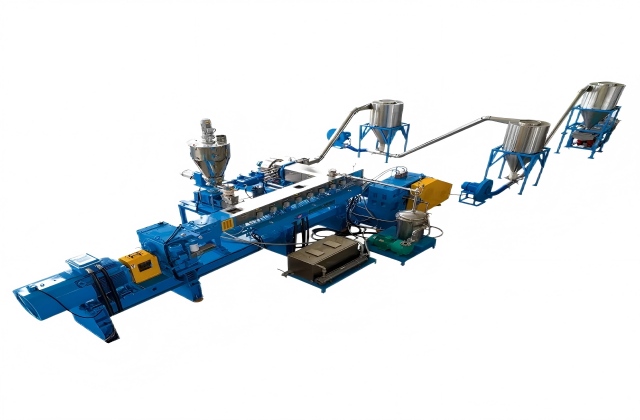
A factory trial should use the actual carrier resin, pigment, filler, and additives whenever possible. The supplier should then demonstrate not only output but also the required product properties.
| Trial Parameter | Recommended Verification |
|---|---|
| Throughput | kg/h at defined operating points |
| Dispersion | Microscopic evaluation |
| Color consistency | Color-strength or ΔE measurement |
| Melt pressure | Stable pressure trend |
| Pellet quality | Size distribution and fines |
| Moisture | Finished-pellet moisture testing |
| Process stability | Continuous production run |
This approach gives the buyer a more realistic understanding of saleable production capacity than a short demonstration based only on nominal extrusion rate.
JWELL's masterbatch technology focuses on the interaction between twin-screw compounding, feeding, screw design, process control, and downstream pelletizing. Its published technical content specifically addresses dispersion, screw design, QC protocols, and troubleshooting.
For manufacturers comparing a filler masterbatch compounding extruder, the critical evaluation should include the complete process configuration and not only the extruder itself.
JWELL's project portfolio also includes masterbatch granulation and compounding applications, providing practical references for different polymer formulations and production requirements.
Typical causes include inaccurate feeding, inadequate wetting, unsuitable screw configuration, insufficient mixing, excessive shear, excessive throughput, poor temperature control, and unsuitable carrier resin.
Not for every formulation, but twin-screw compounding provides strong flexibility for mixing, multiple feeding points, venting, and formulation control, making it widely used for color, filler, and functional masterbatch.
Possible causes include pelletizer settings, brittle material behavior, die configuration, cooling conditions, cutting speed, and unstable melt flow.
Start with stable raw materials, accurate feeding, consistent pigment dispersion, controlled thermal history, and regular comparison against an approved color reference.
No. Machine size must be matched to the formulation, output, torque, screw configuration, dispersion requirement, and downstream pelletizing system.
The acceptance test should verify agreed throughput, formulation accuracy, dispersion, color strength, melt pressure, pellet size distribution, fines, moisture, and continuous operating stability.
A masterbatch extrusion line delivers consistent dispersion and pellet quality when every part of the process is configured around the formulation. Accurate feeding establishes composition, the twin-screw system provides controlled mixing, venting removes unwanted volatiles, filtration stabilizes the melt, and pelletizing converts the compound into a predictable commercial product.
For a serious masterbatch investment, the right question is not simply how many kilograms per hour the extruder can produce. The more meaningful measure is how much saleable masterbatch can be produced repeatedly within the required dispersion, concentration, color, pellet-size, and process-stability specifications.
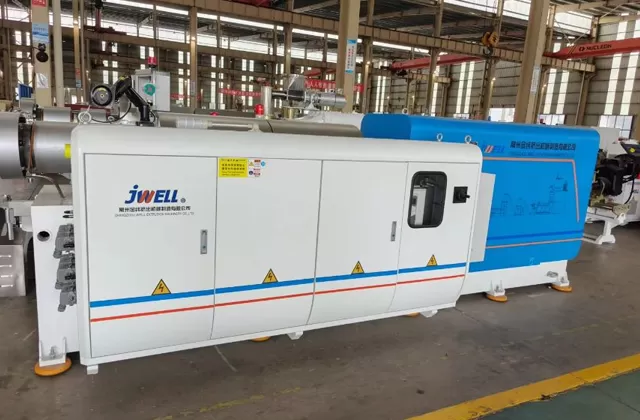
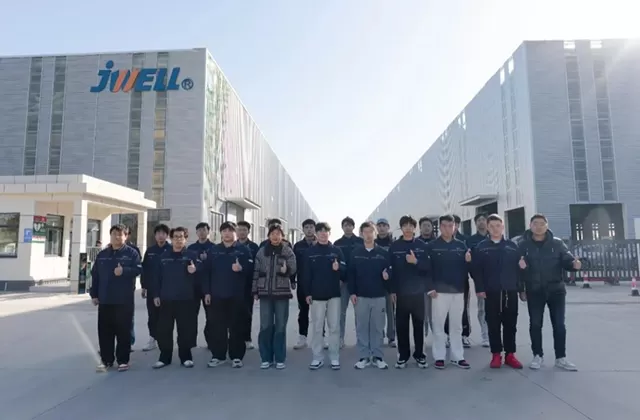

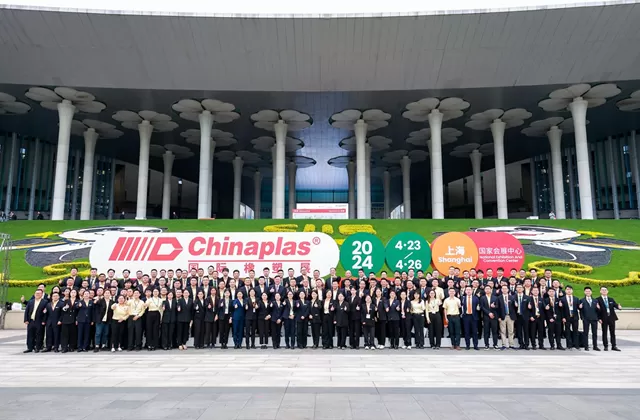
Jwell started manufacturing screws and barrels in 1978, making it one of the earliest screw and barrel manufacturers in China. Its brand, "Jinhailuo", has become well recognized in the industry. In 1997, Jwell was established as a plastic extrusion machinery manufacturer and began the production of extrusion machinery. Today, Jwell is the vice president unit of the China Plastics Machinery Industry Association and one of the technology leaders in the extrusion machinery industry.